
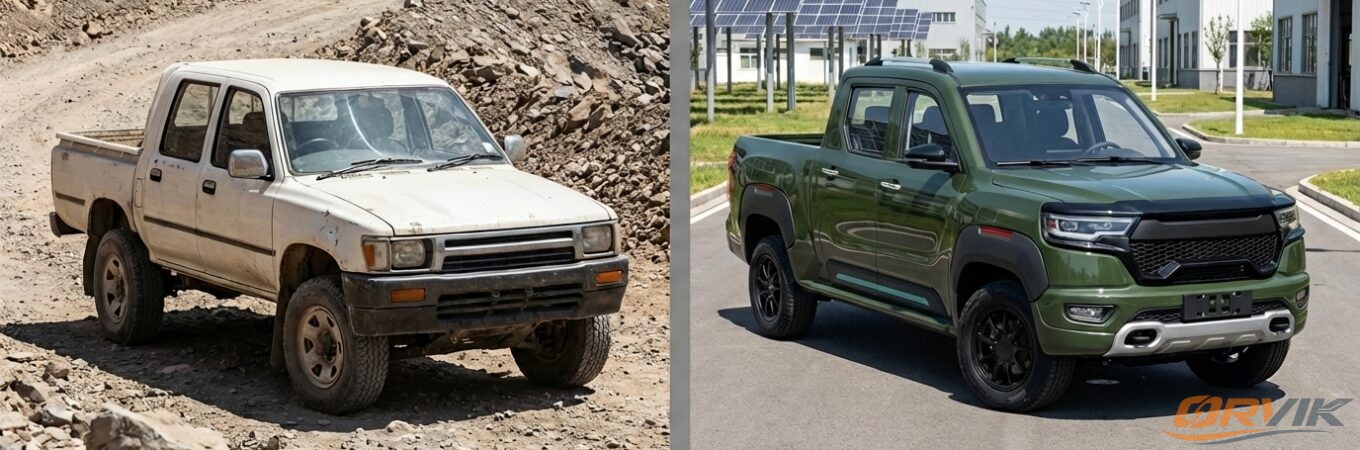
ICE vs. Electric Utility Vehicles: A 5-Year Total Cost of Ownership (TCO) Analysis for Fleet Managers
In the ledger of fleet management, the biggest financial black hole isn’t always long-haul transport; it’s the high-frequency, low-speed short trips within your facility.
Many farm owners and industrial park managers habitually procure gas-powered UTVs or old pickup trucks for patrol and shuttle tasks. However, data shows that running an internal combustion engine (ICE) under “low speed, frequent stop-and-go” conditions is when Total Cost of Ownership (TCO) spirals out of control due to poor thermal efficiency and high wear.
This article strips away the marketing fluff to present a data-driven model comparing a standard Gas Utility Vehicle against an ORVIK Light Commercial Electric Vehicle (LCEV) over a 5-year cycle.
1. The Energy Bill: A Physical “Dimension Reduction” Strike
ORVIK’s product philosophy is simple: “Make work flow.” Whether it’s a 1-ton electric mini truck or a last-mile delivery tricycle, the goal is to precisely match “short-haul, heavy-load” demands in mining sites, resorts, and factories.
Scenario Simulation: Assume a single vehicle operates 60 km/day (round trips within a mine/farm/resort), working 300 days/year, totaling 90,000 km over 5 years.
| Core Metric | Gas Utility Vehicle / Old Pickup | ORVIK Electric Mini Truck (LCEV) | Data Calibration |
| Consumption/100km | 12 L (Inefficient at low speeds) | 10 kWh (Industry standard) | Electric motors are 90%+ efficient |
| Energy Unit Price | $1.0 / L (Global Avg.) | $0.12 / kWh (Industrial Rate) | Electricity prices are stable |
| Cost per 100km | $12.00 | $1.20 | 1/10th the cost of gas |
| 5-Year Energy Spend | $10,800 | $1,080 | Net Saving: $9,720 |
Note: For remote farms or mining sites, utilizing ORVIK’s “Electric farm truck with solar charging” solution can drive this $1,080 cost even closer to zero.
2. Maintenance Costs: Structure Determines Destiny
Gas utility vehicles hate “light work.” Long-term low-speed operation causes severe engine carbon buildup. Coupled with transmissions, oil pumps, and drive belts, they contain thousands of moving parts that require constant attention.
In contrast, ORVIK Electric Utility Vehicles are radically simple:
- Fewer Parts: No oil changes, oil filters, timing belts, or spark plugs. We eliminate the failure points inherent to ICE vehicles.
- Adaptability: Addressing B2B pain points, ORVIK offers customized engineering—the “Middle East Edition” features high-temperature potting controllers for extreme heat, while the “Russian Edition” includes battery heating systems for arctic cold.
Data Comparison: A comparable gas UTV requires approx. $500-$800 in annual maintenance. An ORVIK vehicle averages just $150 (mostly tires and brake checks), reducing maintenance costs by roughly 70%.
3. Procurement Model: The “Factory-Direct” Bonus
Beyond Operating Expenses (OpEx), Capital Expenditure (CAPEX) is critical. Traditional gas UTVs are often sold through layered distribution networks with high brand markups.
ORVIK operates on a “China EV factory direct supply” model,This means fleet managers can bypass middlemen and acquire professional industrial vehicles at near-wholesale prices. You can essentially outfit a zero-emission fleet for the price of a used gas pickup.
4. The 5-Year TCO Settlement: ROI Made Clear
Combining procurement, energy, and maintenance, here is the clear 5-year financial breakdown for a 1-ton utility vehicle:
| Financial Dimension (5-Year) | Branded Gas UTV / Used Pickup | ORVIK Electric Utility Vehicle | Notes |
| Initial CAPEX | $14,000 (Est. Avg.) | $8,000 (Factory Direct Est.) | Removing middleman markup |
| 5-Year Energy Cost | $10,800 | $1,080 | Based on 90,000 km |
| 5-Year Maintenance | $3,500 | $750 | Structural simplicity advantage |
| Total Cost of Ownership | $28,300 | $9,830 | Cost Reduction > 65% |
| Total Savings | – | $18,470 | Enough to buy 2 more units |
Conclusion
The data doesn’t lie. For managers operating in mining sites, industrial parks, or large-scale agriculture, continuing to buy gas vehicles for “short-haul chores” is no longer financially defensible.
Choosing ORVIK isn’t just buying a vehicle; it’s choosing an “off-grid operation ecosystem” [3]. By lowering the barrier to entry through factory-direct pricing and slashing energy costs by 90% through electrification, we ensure every dollar of your budget is spent on improving workflow efficiency.
While your competitors are stressing over fluctuating fuel prices, your fleet has quietly completed its asset upgrade using low-cost electricity.
Ready to lower your fleet costs? Contact ORVIK for a factory-direct FCL quote today.

 English
  Russian
  Portuguese
  Arabic
  Japanese
  Korean
  Spanish
  French
  Hungarian