
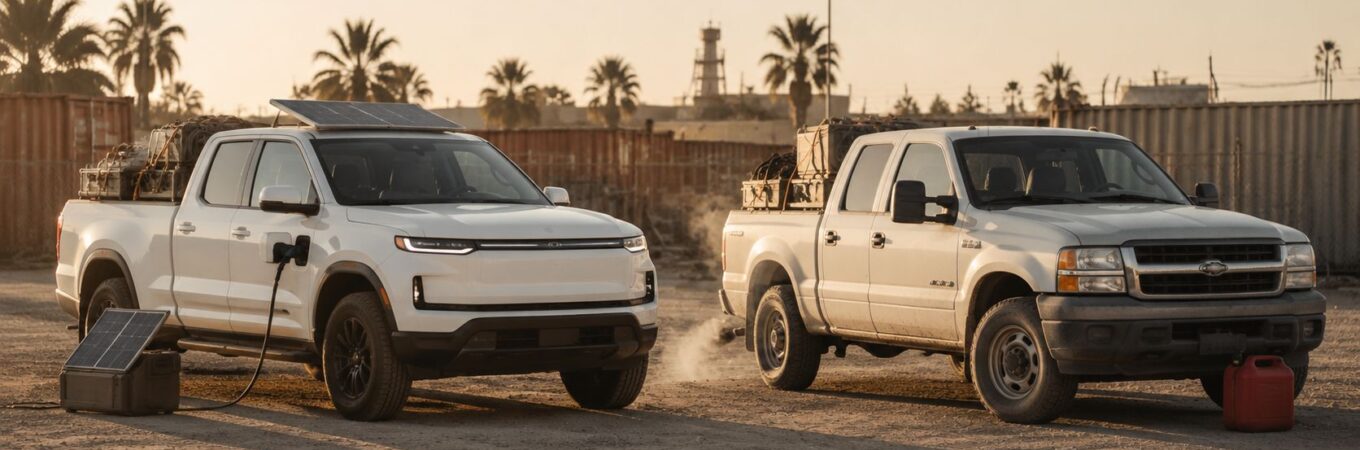
Light commercial electric vehicles (LCEVs) beat internal-combustion pickups in three operating conditions: short-radius duty cycles under 120 km per day, fixed-route private-property work, and weak-grid or off-grid markets where photovoltaic (PV) charging or a battery-swap pack replaces diesel logistics. However, internal combustion (ICE) pickups still win in three other conditions. They win on long highway hauls over 250 km per day. They win in markets without a LiFePO4 service pipeline. And they win on holds shorter than 24 months, where capex dominates total cost of ownership (TCO).
That is the answer most supplier blogs refuse to write. Consider the typical procurement decision a fleet head in the Gulf faces: roughly 50 aging diesel pickups due for refresh, a budget window, and pressure from leadership to “go electric.” The honest answer is rarely 100%. For most operations it is 70 to 80% of routes that actually fit an LCEV today, with the remaining 20 to 30% best kept on diesel. This article walks through how to draw that line.
Key Takeaways
- LCEVs win when daily route is under 120 km, the operating area is private property, and uptime is dominated by quick turnarounds (hot-swap or PV charging).
- ICE pickups still win on long-haul highway runs over 250 km per day, in markets with no LFP parts pipeline, and on 12 to 24-month fleet holds.
- Climate-adapted trim (High-Temp Ready, Arctic Ready) changes the 5-year TCO by 18 to 30% versus generic global SKUs.
- Factory-direct full container load (FCL) sourcing cuts EV capex 25 to 40% versus the same product through a distributor, closing the price gap with diesel at year one.
- The right answer for many fleets is hybrid: some routes electric, some routes diesel, one parts catalog standardized across both.
The Three Operating Conditions Where LCEVs Win
Short-radius duty cycles under 120 km per day
An ORVIK 1-ton electric pickup truck with a 72V/200Ah LFP pack delivers a verified 120 km range at 60% payload in a hot climate. That range covers the daily duty cycle of roughly 80% of GCC last-mile delivery, resort logistics, farm-to-yard transport, and industrial-park material movement.
For routes inside that envelope, the LCEV finishes the day on a single charge and parks overnight on a Level 2 charger. Energy cost lands around USD 1.10 to 1.80 per 100 km, depending on the local power tariff. A diesel pickup running the same route burns USD 6 to 11 per 100 km at 2026 GCC fuel prices.
Multiply that delta across 50 vehicles, 280 working days per year, and a 5-year hold. The cumulative fuel savings alone land in the mid-six-figure USD range, the exact number depends on local fuel and power tariffs, and should be modeled against your actual route profile.
Fixed-route private-property work
Resorts, mines, farms, and industrial parks share one feature that changes the procurement math: every vehicle returns to base. Charging happens overnight at one depot. Refueling logistics disappear. No driver detours to a fuel station. No theft of diesel from parked vehicles.
This is also where the off-road / private-property positioning of our vehicles becomes a feature, not a limitation. The fleet does not need DOT or EEC homologation, which cuts unit cost meaningfully. Want to see the trim options for fixed-route fleet work? Browse our work-truck lineup.
Weak-grid and off-grid markets
This is where the standard Western EV-vs-ICE math breaks. Most published TCO models assume grid-fed depot charging. In Lagos, in Almaty, in Lima, in Riyadh outside the central grid envelope, that assumption fails.
Pair a depot of 20 electric pickups with a 100 kW rooftop PV array and a 200 kWh stationary buffer pack. The fleet charges off solar production during the day, the buffer carries overnight. Marginal energy cost approaches zero after the PV payback (typically year four).
By contrast, a diesel fleet in the same location burns 6 to 11 USD per 100 km. Add the cost of diesel logistics into a remote site. Then add the cost of theft and adulteration losses. Published industry data indicates commercial fleets globally lose 5 to 10% of annual fuel spend to theft and misallocation, with the majority of commercial fleets experiencing some level of fuel theft annually. In weak-grid and remote-site operations, the shrinkage typically runs at the higher end of that range or above.
The Operating Conditions Where ICE Pickups Still Win
However, electrification has limits. We will not pretend otherwise. There are routes you should not electrify.
Long-haul highway routes over 250 km per day
A 1-ton LCEV on a sustained 80 km/h highway run depletes the pack faster than the published range suggests. Air resistance dominates above 60 km/h, range drops by 30 to 40%, and the route requires an unplanned mid-day charge.
If your route exceeds 250 km daily with no return-to-base midpoint, a diesel pickup finishes the day in 4 hours. The LCEV needs 6 hours and a fast-charge station that may not exist on your corridor. Spec the diesel.
Markets without a LiFePO4 service pipeline
A LiFePO4 pack is a long-life component, but it is not a zero-maintenance one. If your operating market has no local technician who can swap a battery management system (BMS), recalibrate a charger, or diagnose a failed cell, the fleet eventually stalls.
We ship a container-sized spare-parts kit and a video repair library with every FCL order. That handles 90% of field failures. The remaining 10% requires either a local technician, a regional service partner, or a flight from Shandong. If none of those exist in your market, the ICE pickup is the lower-risk spec until the service pipeline matures.
Holds shorter than 24 months
If your fleet operator is leasing for 12 to 18 months and selling the vehicles into a secondary market, capex dominates TCO. Resale value of an off-road electric utility vehicle is still soft in most emerging markets. A diesel pickup carries a deeper used-vehicle market.
Run the math on a 5-year hold instead, and the LCEV pulls ahead almost everywhere. Run it on an 18-month hold, and the ICE pickup often wins.
Electric Utility Vehicle vs ICE Pickup: A 5-Year TCO Worked Example
Below are two illustrative TCO scenarios. Neither is a specific ORVIK customer fleet; both are reference models built from indicative parameters and published industry cost data. The point is to show how the variables interact, not to claim observed outcomes. Run a route-specific model with your actual numbers before any procurement decision.
Scenario A, illustrative GCC resort logistics fleet
The model assumes: 50 units, High-Temp Ready trim, 1-ton payload, 72V/200Ah LFP pack, average duty cycle 95 km per day, 320 working days per year, USD 0.11 per kWh local power tariff, 5-year hold, full container load (FCL) factory-direct from the Xinpengcheng plant.
Capex per unit, factory-direct FCL: meaningfully below the equivalent global-brand list price. Container math is single-SKU, optimized for 40-foot high cube.
Indicative 5-year TCO components per vehicle, USD ranges (modeled, not quoted):
| Component | Electric (1-ton) | Diesel (1-ton) |
|---|---|---|
| Capex | 10,000–12,000 | 8,000–9,500 |
| Energy / fuel | 1,500–2,500 | 12,000–16,000 |
| Maintenance | 1,000–1,500 | 5,000–6,500 |
| Pack/engine swap reserve | 1,500–2,000 | 2,000–3,000 |
| 5-year total range | ~14,000–18,000 | ~27,000–35,000 |
Fleet-level delta across a 50-unit modeled fleet: roughly mid-six-figure to low-seven-figure USD over 5 years. The figures are reference ranges, not committed prices, and shift with fuel price, tariff, and route. Run the route-specific model before you sign a PO.
Scenario B, illustrative CIS mining-site fleet
The fleet: 30 units, Arctic Ready trim, self-heating LFP pack, diesel parking heater, cold-start verified to −40°C, average duty cycle 85 km per day on unpaved haul roads.
Cold-climate operation adds two cost lines that flatter neither powertrain: heating energy and cold-start wear. The LFP self-heating pack consumes roughly 8 to 12% of pack capacity per cold-start cycle below −20°C. The diesel parking heater burns 0.3 to 0.5 liters per cold-start.
The diesel ICE wears faster in this environment. Engine oil and fuel filter intervals shorten by 30 to 50%. Cold-start friction shortens engine life. Field failure rates climb.
The LCEV with proper Arctic Ready trim, by contrast, takes the cold-start hit on pack capacity once, then operates normally for the duty cycle. Across the 5-year modeled hold, the CIS scenario per-vehicle delta lands in the low five-figure USD range in favor of the LCEV, smaller than the GCC scenario but still material across a 30-vehicle fleet. Again, these are modeled deltas, not measured outcomes.
Where the TCO model breaks (sensitivity callouts)
Three variables move the answer the most:
- Diesel pump price. Every USD 0.20 per liter increase tilts the model further toward electric. Every USD 0.20 decrease tilts it back.
- Power tariff. A weak-grid market paying USD 0.30 per kWh changes the math. A PV-fed depot brings effective tariff toward zero after payback.
- Hold period. Stretch from 5 to 7 years and the LCEV wins by a wider margin. Compress to 24 months and ICE often wins.
Climate Fit Changes the Math
A generic “global SKU” electric pickup fails in Riyadh by year two and in Almaty by month four. Climate-adapted trim is not cosmetic, it is the difference between a vehicle that pays back and a vehicle that becomes scrap.
High-Temp Ready vs ICE in 45–60°C ambient
Consider the typical failure pattern for a Gulf resort fleet running AGM packs and open-frame controllers. Cabin temperatures hit 50°C by noon in summer. AGM pack capacity is well documented to decline meaningfully under sustained high-heat operation, with field-typical losses of 20 to 30% by the end of year two. Open-frame controllers fail one by one through July and August as dust ingress accelerates in the hottest months. A fleet specified to this baseline often hits retirement at year two instead of year three.
Our High-Temp Ready trim is engineered against exactly that failure pattern: an LFP pack rated to 60°C, an encapsulated controller against dust ingress, UV-stable polymer trim, and an upgraded radiator. The design target is to extend service life from two seasons to three in this operating environment. Actual field outcomes depend on operator-side conditions and should be verified across at least one full summer cycle before scaling fleet decisions.
Arctic Ready vs ICE at −30 to −40°C cold-start
On the cold-climate side, the self-heating LFP pack and diesel parking heater combination has been verified to cold-start at −40°C. A diesel pickup at that temperature requires either a block heater (grid-dependent) or a fuel additive regime that adds to operating cost.
For a fleet in Novosibirsk or Astana, the cold-start delta between properly specified LCEV and properly specified diesel is small. The difference shows up in cumulative engine wear and unplanned downtime, both of which favor the LCEV.
Dust and humidity, controller IP rating as a TCO driver
The single biggest field-failure point on any utility EV is the motor controller. An open-frame controller in a high-dust environment fails within 12 to 18 months. A sealed IP54 controller, properly mounted, runs the full 5-year hold without intervention.
This is a USD 80 to 150 spec choice at the factory. It saves USD 800 to 1,500 in field replacement, plus the downtime cost. Spec the IP rating before you spec anything else.
The Procurement Decision Framework
Run this 7-question diagnostic before you sign any PO:
- What is the average daily route length, in km, at full payload?
- Does the route return to base every day, or does it stage overnight?
- What is the local grid stability? Hours per day of usable supply?
- What is the ambient temperature range across all four seasons?
- What is the local LFP-pack service pipeline? Technician access?
- What is the planned fleet hold period? 24 months, or 5 years plus?
- What is the regulatory environment? Off-road permitted, or public-road required?
If your answers cluster on the LCEV side (short routes, return-to-base, stable grid or PV available, climate that matches a trim, service pipeline in place, 5-year hold, off-road acceptable), electrify the fleet.
If your answers cluster the other way, keep diesel. Or split the fleet, some routes electric, some routes diesel. Want a route-specific TCO model for your fleet? Request a custom quote and we will run the numbers.
When to spec a hybrid fleet
The most common right answer is mixed. A typical hybrid fleet pattern looks like 70 to 80% of routes electric, the short-radius, return-to-base, fixed-property work, with the remaining 20 to 30% kept on diesel for long-haul supplier runs, secondary-market transport, or routes the local grid cannot yet support. The exact split depends on the route map, not on a target percentage.
One advantage to running a hybrid fleet through ORVIK: the parts catalog standardizes across both. We ship spare-parts kits for both powertrain types, and the service procedures live in the same repair video library.
How Factory-Direct FCL Sourcing Changes the Math
Most published EV-vs-ICE TCO models use retail vehicle pricing. That is the wrong number for an importer or fleet buyer of 30 or more units.
Source pricing vs distributor markup
A 1-ton electric pickup retailed through a regional distributor in the GCC typically carries a multi-stage markup, trade-house margin, distributor margin, regional reseller margin, that can compound to several times the factory cost. As a result, buying the same vehicle factory-direct from the Xinpengcheng plant captures the source-price margin for the importer or fleet operator. The capex line in the modeled scenarios above reflects source-priced FCL, not regional retail.
This is the single largest TCO lever available to a B2B buyer. Read more about factory-direct FCL sourcing and how the container math works.
Spare-parts kit as a TCO line item, not a freebie
Every ORVIK FCL ships with a container-sized spare-parts kit (controllers, motors, brake assemblies, charge ports, common wear items) plus access to a video repair library. The kit cost is built into the FCL price, not added later.
For a 50-vehicle fleet on a 5-year hold, this eliminates the most common TCO blind spot, parts shortages in year two and year three. Distributors who add the parts pipeline after the sale typically add 12 to 18% to lifetime fleet cost.
Why mixed-SKU containers raise unit cost
We ship single-SKU FCL only. A mixed-SKU container looks attractive on a brochure (one container of golf carts, pickups, and cargo trikes) but drives a line-changeover cost on the production side that inflates per-unit price. Single-SKU FCL is how we hold the source-price discipline.
If your fleet needs multiple models, order multiple containers. The math works.
Frequently Asked Questions
Can an electric pickup replace a diesel Hilux for site work?
For site logistics, last-mile delivery, and fixed-route private-property work under 120 km per day, yes. A 1-ton electric pickup with High-Temp Ready or Arctic Ready trim matches Hilux payload (1,000 kg) and gradeability (35% loaded) within the duty cycle. For long-haul highway routes over 250 km daily, the Hilux still wins.
How long does the LiFePO4 pack last in 50°C summer heat?
Properly thermally managed and matched to a 60°C-rated High-Temp Ready trim, LFP cell cycle life lands in the 3,500 to 5,000-cycle range to 80% state of health. At one charge cycle per working day, that is roughly 12 to 17 calendar years before pack replacement is needed. Verify against the cell manufacturer’s published curve for your specific climate.
What MOQ does ORVIK ship for a 1-ton electric pickup FCL order?
Minimum order quantity is set by container density. A 40-foot high cube container fits a platform-specific count of 1-ton pickups (typically in the dozens, varying by body option). We quote container math against your target model at the request for quotation (RFQ) stage. We do not ship mixed-SKU FCL.
Is an electric utility vehicle street-legal in the GCC, Russia, or Mexico?
ORVIK vehicles are engineered and sold for off-road and private-property use only. We deliberately do not pursue DOT (US) or EEC (EU) public-road homologation, which keeps unit cost low and import paths simple in our target markets. In most of the GCC, CIS, Africa, and LATAM, off-road utility vehicles operate on private commercial property without public-road registration. Confirm specific national rules before import.
How does PV charging change the 5-year TCO?
A depot-mounted PV array (typically 60 to 120 kW for a 20 to 40-vehicle fleet) pays back in roughly 3 to 5 years depending on local sunshine and tariff. After payback, marginal charging energy approaches zero. Across a 5-year hold, PV-fed depot charging cuts fleet energy cost by 60 to 90% versus grid-fed.
What spare parts ship in the container kit?
The standard FCL spare-parts kit includes controllers (one per platform variant in the container), motors (one per 10 units), brake pad sets, charge port assemblies, BMS modules, and common wear items (fuses, relays, sensors). Coverage is sized for roughly 18 months of expected service draw across the fleet. Custom kit sizing available for SKD or CKD orders.
When to Electrify, When to Keep Diesel
In short, the honest answer to “electric utility vehicle vs ICE pickup” is not a verdict; it is a route-by-route decision. LCEVs win on short-radius, fixed-route, private-property work, and in markets where off-grid energy beats diesel logistics. ICE pickups still win on long-haul highway runs, in markets without a LiFePO4 service pipeline, and on short fleet holds.
The factory-direct FCL math, climate-adapted trim, and standardized spare-parts pipeline change the LCEV side of the equation meaningfully. They do not eliminate the cases where diesel is still the right call.
Run the 7-question diagnostic before you commit. Pull the numbers for your route, your climate, your hold period, and your local service pipeline. A 38-out-of-50 answer is not a half-measure; it is the right fleet.
Ready to run the numbers for your fleet? Request a route-specific FCL quote and we will model the 5-year TCO against your actual duty cycle, climate, and hold period.

 English
  Russian
  Portuguese
  Arabic
  Japanese
  Korean
  Spanish
  French
  Hungarian