
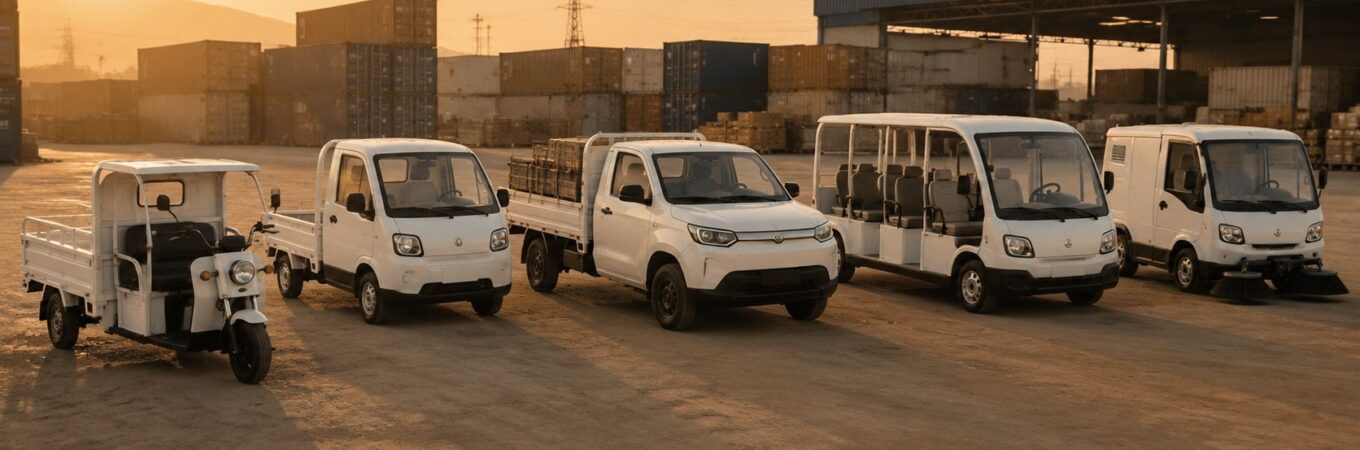
A light commercial electric vehicle (LCEV) is a battery-electric work vehicle with a gross vehicle weight rating (GVWR) up to 3.5 tonnes, pickups, mini-trucks, cargo tricycles, sweepers, and shuttles built for fleet duty rather than consumer driving. For B2B buyers in 2026, the right LCEV is defined less by its badge and more by its match to four variables: daily duty cycle, operating climate, grid reliability, and intended hold period.
The Middle East and Africa EV market is forecast to grow from USD 5.06 billion in 2026 to USD 20.39 billion by 2031, a 32% compound annual growth rate. Saudi Arabia alone is projected to triple its electric light commercial vehicle unit volume between 2024 and 2026, from 400 to 600 units in 2024 up to 1,200 to 1,800 units in 2026. Despite that acceleration, most published “what is an LCEV” content on Google in 2026 was written for a US fleet operator buying a Rivian or a Ford E-Transit. This guide is built for the other audience: importers and fleet buyers across the GCC, Russia/CIS, Africa, and Latin America who need a buyer framework, not a category marketing brochure.
Key Takeaways
- An LCEV is a battery-electric work vehicle under 3.5 tonnes GVWR, pickups, mini-trucks, cargo tricycles, sweepers, shuttles, engineered for commercial duty cycles, not consumer driving.
- The Middle East and Africa EV market is on a 32% CAGR (USD 5B in 2026 to USD 20B by 2031); Saudi Arabia is tripling eLCV unit volumes year on year.
- The right LCEV is route-defined, not badge-defined: daily route, climate, grid, and hold period decide more than brand.
- Off-road / private-property positioning sidesteps DOT and EEC certification cost, material savings for fleets that operate inside resorts, mines, farms, industrial parks, and gated communities.
- Factory-direct full container load (FCL) sourcing typically captures multiple layers of distributor margin and standardizes the spare-parts pipeline at order time.
What Counts as a Light Commercial Electric Vehicle
A light commercial electric vehicle, abbreviated LCEV (or eLCV in some industry reports), is a battery-electric vehicle engineered for commercial work. Three criteria define the category.
Powertrain: 100% battery-electric. Plug-in hybrid electric vehicles (PHEVs) are tracked in some market reports but rarely show up in fleet-duty work segments, where battery-electric (BEV) is the dominant choice for total cost of ownership reasons.
Weight class: Gross vehicle weight rating up to 3.5 tonnes. This is the regulatory definition used in EU and most other markets (per Dolphin Charger’s LCV explainer). In the United States, the equivalent bracket is Classes 1 through 2a, covering vehicles with a GVWR up to 8,500 lbs (approximately 3.86 tonnes), per the US Department of Energy Alternative Fuels Data Center.
Intended use: Commercial. The vehicle is built for an operator job, deliver, patrol, haul, sweep, shuttle, not for personal transport. This shapes the engineering: payload-first chassis, fleet-grade durability, repair-friendly architecture, and standardized parts.
How LCEV fits in the broader EV category
The EV landscape is not one market. It splits into four broad layers:
| Layer | Examples | Primary buyer |
|---|---|---|
| Passenger EV | Tesla, BYD Atto, EU consumer sedans | Individuals |
| Light commercial EV (LCEV) | 1-ton pickups, cargo tricycles, golf carts, sweepers | Fleet operators, importers |
| Medium / heavy commercial EV | Class 2b–8 trucks, buses | Logistics carriers, transit authorities |
| Specialty / industrial EV | Mining haulers, port equipment | Industrial operators |
ORVIK builds exclusively in the LCEV layer. The category sits between passenger consumer EVs (which are over-engineered and over-priced for fleet work) and heavy commercial trucks (which are over-powered and over-regulated for the operator jobs we serve).
Why “light commercial” is not the same as “passenger EV”
A consumer EV optimizes for range, acceleration, and cabin comfort. An LCEV optimizes for payload, gradeability, uptime, and serviceability in field conditions. The two share the term “electric” but solve different problems.
Want a complete spec breakdown of our LCEV product matrix? Download the ORVIK product catalog, single PDF covering all four product families.
LCEV Classifications and Vehicle Types
The LCEV category includes a wider range of vehicle types than most first-time buyers expect.
Weight class definitions
| Class | GVWR (US) | GVWR (metric equivalent) | Typical applications |
|---|---|---|---|
| Class 1 | Up to 6,000 lbs | Up to 2.72 tonnes | Cargo tricycles, mini-trucks, small utility pickups |
| Class 2a | 6,001 to 8,500 lbs | 2.72 to 3.86 tonnes | 1-ton pickups, light delivery vans, golf carts (heavier configs) |
| Class 2b (boundary) | 8,501 to 10,000 lbs | 3.86 to 4.54 tonnes | Heavier delivery vans, light-medium duty work trucks |
In most ORVIK target markets, the practical LCEV definition stays at or below 3.5 tonnes, which keeps the vehicle inside off-road / private-property regulation in jurisdictions that distinguish public-road LCVs from work-only utility vehicles.
Body and platform types
Within the LCEV weight band, the body styles diverge sharply by application:
- Electric pickup truck (1-ton payload): Site logistics, mining-site material transport, farm-to-yard haul, last-mile delivery for GCC fleets.
- Electric mini-truck: Compact urban delivery, in-plant logistics, last-mile parcel.
- Electric cargo tricycle (300 to 500 kg payload): Last-mile delivery workhorse, especially in Africa and Latin America.
- Electric passenger tricycle: Short-haul mobility, tuk-tuk-style transport.
- Electric golf cart: Resort fleets, hotel grounds, villa communities.
- Electric LSEV / commuter: Campus, gated community, short-range enclosed-cabin transport.
- Electric sightseeing / shuttle bus: Resort and hotel guest transport, theme parks, scenic-area shuttles.
- Electric street sweeper: Municipal cleaning, industrial-park grounds.
- Electric patrol vehicle: Security, campus safety, resort patrol.
The right body style is set by the operator job, never the reverse. A fleet head who starts by asking “what model has the longest range” is solving the wrong problem. The right question is “what job is the vehicle doing, where, and on what route.” The body and chemistry follow.
BEV versus PHEV in the LCEV segment
LCEV markets globally have settled on pure battery-electric. Plug-in hybrid drivetrains add weight, cost, and a second maintenance pipeline (combustion engine + transmission), which erodes the operational economics for short-radius fleet work. Most off-road and private-property LCEV applications run on duty cycles short enough that PHEV becomes irrelevant.
Why B2B Fleet Buyers Are Switching in 2026
The shift to LCEV is no longer a future story. It is a 2026 procurement reality, and the data backs it.
Market growth picture
The global electric light commercial vehicle market is projected to reach USD 116.60 billion by 2032, according to MarketsandMarkets. Regional growth concentrates in three blocks: the Middle East and Africa (32% CAGR per Mordor Intelligence), Latin America, and the CIS region. The European Union adopted the Euro 7 emission rules in April 2024, with enforcement phasing in for light-duty vehicles from mid-2025, which further accelerates zero-emission LCV adoption in EU-facing markets.
Charging infrastructure is following demand. Abu Dhabi’s ADNOC and TAQA joint venture E2GO has announced plans to install up to 70,000 EV charging points across the emirate by 2030, while Dubai’s DEWA network surpassed 1,270 public charging sites in 2025 against its earlier 1,000-site target. In off-road and private-property fleet operations, depot charging and PV-fed depots are eliminating the public-charging dependency entirely.
Total cost of ownership drivers
For a fleet operator doing the math, three lines move the LCEV-versus-ICE decision:
- Fuel versus electricity per kilometer. At typical GCC power tariffs and 2026 fuel prices, an LCEV’s energy cost per kilometer runs roughly an order of magnitude below a comparable diesel pickup. Across a multi-year fleet hold the cumulative delta is meaningful, the specific number depends on tariff, fuel basis, and route, and should be modeled against your operation rather than assumed from a published example.
- Maintenance. An electric drivetrain has fewer moving parts than a combustion equivalent, no oil changes, no fuel filters, no exhaust system, far less brake wear thanks to regenerative braking. Maintenance cost per kilometer drops accordingly.
- Fuel shrinkage and theft. Industry reporting indicates commercial fleets can lose up to 6% of fleet fuel costs to theft, with a meaningful share of that loss attributed to internal misallocation rather than external pilferage. In weak-grid and remote-site operations, exposure tends to run at the higher end of that range. An LCEV that charges from a metered depot eliminates this category of loss entirely.
Regulatory tailwinds
Beyond Euro 7, sovereign-fund allocations in GCC oil-exporting nations are now directly funding domestic eLCV ecosystems. The picture matters for two reasons. First, regional content rules are getting written into procurement tenders, which favors suppliers offering SKD or CKD kit-form imports for in-country assembly. Second, government fleet procurement signals are pulling private-sector fleet decisions along with them, when a national port authority electrifies its on-site logistics fleet, surrounding operators tend to follow.
Ready to see how an LCEV order works in your market? Browse our work-truck lineup for the spec sheets, then talk to our team about FCL container math for your region.
The Four Variables That Decide the Right LCEV
The right LCEV is route-defined, not badge-defined. Run the diagnostic before you spec the vehicle.
Variable 1: Daily duty cycle
How many kilometers per day, at what payload, with what charging window? A 1-ton electric pickup with a 72V/200Ah LFP pack is typically rated in the 100 to 130 km range at 60% payload, with the lower end of the range applying in hot-climate operation where battery cooling load reduces effective output. That range envelope covers a large share of typical GCC last-mile delivery, resort logistics, farm-to-yard, and industrial-park material movement.
For routes over 250 km daily with no return-to-base midpoint, a diesel pickup is still the right call until the public fast-charging network in your corridor matures. We covered this trade-off in detail in the LCEV-versus-ICE pickup comparison.
Variable 2: Operating climate
A vehicle built for Shanghai will fail in Riyadh or Yakutsk. Climate-adapted trim is the difference between a fleet that pays back and a fleet that becomes scrap by year two.
- High-Temp Ready (Middle East, North Africa): Upgraded radiator, gel-encapsulated controller (against dust and heat ingress), UV-stable polymer trim, LFP pack rated to 60°C ambient.
- Arctic Ready (Russia, CIS, Kazakhstan): Self-heating LiFePO4 pack, diesel parking heater, low-temperature lubricant, cold-start verified to −40°C.
- Off-Grid Ready (Africa, remote LATAM, weak-grid GCC): Rooftop PV charging module, swappable battery rack, weak-grid tolerant charger (110 to 250V AC input).
Generic “global SKU” trim almost always fails in extreme climates. Read more about ORVIK’s climate-adapted trim packages before you finalize the spec.
Variable 3: Grid reliability
Grid context changes the energy math entirely.
Stable grid: Standard depot charging. Energy cost runs at the local tariff. Done.
Weak grid: Pair the depot with a stationary buffer pack (50 to 200 kWh) that charges during high-supply windows and carries through outages. Add a weak-grid tolerant charger.
Off-grid: A 100 kW rooftop PV array plus a stationary buffer pack covers a depot of 20 to 30 LCEVs. After the PV payback (typically year four), marginal energy cost approaches zero. This is the operating profile where LCEVs most strongly beat ICE, since the comparison shifts from “electricity versus diesel” to “PV versus diesel logistics.”
Variable 4: Hold period
The TCO math runs very differently on a 24-month hold versus a 5-year hold.
24 months or less: Capex dominates. Resale value of off-road LCEVs is still soft in most emerging markets. A diesel pickup carries a deeper used-vehicle market. The ICE answer often wins.
5 years or more: LCEV pulls ahead almost everywhere. Maintenance savings compound. Fuel delta compounds. The capex disadvantage shrinks against the lifetime operating delta.
Most B2B fleets in our target markets run 5 to 7-year holds. The math works.
How to Source an LCEV: Factory-Direct Versus Distributor
Most published LCEV buyer guides assume retail purchase from a regional dealership. That is the wrong frame for an importer or a fleet buyer of 30 or more units.
The price stack
When an LCEV moves from the factory to an end fleet operator through a distributor channel, the price compounds across several margins:
- Factory cost
- Trade-house or export-house margin
- Importer or regional distributor margin
- Regional reseller margin
- End-buyer retail
By the time the vehicle reaches the fleet operator, the retail price typically sits at several times the factory cost. Factory-direct full container load (FCL) sourcing collapses that stack, with the importer or fleet operator capturing the source-price margin directly.
FCL container economics
We ship single-SKU FCL only. The container math:
- One model per container. Mixed-SKU loading drives line-changeover cost in the plant and inflates per-unit price.
- Single-SKU 40-foot high cube. Unit count depends on body style: dozens of pickups, scores of cargo tricycles or golf carts.
- Standard 12-month factory warranty. Container-sized spare-parts kit included. Video repair library access.
- Climate trim specified at purchase order. High-Temp, Arctic, or Off-Grid. Not retrofitted later.
If your fleet needs multiple models, order multiple containers. The math works.
SKD and CKD options for in-region assembly
Some markets (parts of Russia, CIS, North Africa, and selected LATAM countries) apply tariff or local-content rules that favor kit-form imports. ORVIK supports semi-knockdown (SKD) and complete-knockdown (CKD) production, where the vehicle ships disassembled and final assembly happens at an in-country partner. This sidesteps full-vehicle import duty in many jurisdictions and creates local assembly jobs that support tender qualification.
Spare-parts pipeline as a buy criterion
The single most common procurement blind spot in emerging-market fleet purchases is the parts pipeline. A vehicle that lands cheap and dies 18 months later because no controller spare is available has cost more than a vehicle that landed 15% more expensive with the right kit.
Every ORVIK FCL ships with a container-sized spare-parts kit covering 90% or more of common field failures (controllers, motors, brake assemblies, charge ports, BMS modules, fuses, sensors). The kit cost is built into the FCL price, not added later. Sized to roughly 18 months of expected service draw across the fleet.
Common Procurement Pitfalls (And How to Avoid Them)
Three patterns repeat across first-time LCEV procurement decisions:
Pitfall 1: Over-spec the vehicle, under-spec the parts kit
A fleet buyer optimizes capex against vehicle features and treats spare parts as an afterthought. Two years later, the fleet stalls on a USD 150 controller that takes 4 months to source. Reverse the priority: spec the parts kit first, then the vehicle.
Pitfall 2: Buy a generic global SKU into a hot or cold climate
A vehicle marketed as “international” usually means “engineered for European or Chinese coastal climate.” Drop the same vehicle in Riyadh or Almaty and the AGM pack collapses by year two or the controller fails on the first 50°C summer day. Climate-adapted trim is non-negotiable in extreme markets. Specify it at the purchase order, not as an aftermarket retrofit.
Pitfall 3: Assume public-road certification when you operate off-road
A surprising number of LCEV buyers chase DOT (US) or EEC (EU) homologation when their actual operating environment is private property, a resort, a mine, an industrial park, a gated community. Off-road / private-property positioning sidesteps that certification cost entirely. Most ORVIK target markets accept this distinction. Confirm local rules before importing, then size the spec correctly.
Frequently Asked Questions
What is the difference between an LCEV and a regular EV?
A regular EV (passenger car) optimizes for personal transport: range, acceleration, cabin comfort. An LCEV optimizes for commercial work: payload (300 kg to 1,000 kg), gradeability (up to 35% loaded), uptime, and serviceability in field conditions. The two share the term “electric” but solve different problems. Most LCEVs are also positioned for off-road / private-property use, which simplifies regulatory compliance in fleet-buyer markets.
What does “off-road / private-property use” mean for fleet buyers?
It means the vehicle is engineered and sold for operation on private commercial property, resorts, mines, farms, industrial parks, ports, gated communities, campuses, not for public roads. This positioning sidesteps DOT (US) and EEC (EU) public-road homologation, which keeps unit cost low and import paths simple in most of the GCC, CIS, Africa, and LATAM. Confirm local rules in your specific market before import.
What MOQ is typical for an LCEV factory-direct FCL order?
Minimum order quantity is set by container density, not by an arbitrary unit count. A 40-foot high cube container fits a platform-specific number of vehicles: dozens of 1-ton pickups, scores of cargo tricycles or golf carts. Single-SKU FCL is the standard configuration. We quote container math against your target model at the request for quotation stage.
How long does a LiFePO4 pack last in extreme climates?
Properly thermally managed and matched to a 60°C-rated trim (for hot climates) or a self-heating pack (for cold climates), LFP cell cycle life is typically published in the 3,500 to 5,000 cycle range to 80% state of health. At one charge cycle per working day, that range works out to roughly 12 to 17 calendar years before pack replacement is needed. Verify the cell manufacturer’s published curve for your specific climate before finalizing the spec.
Is an LCEV suitable for mining, farm, or last-mile delivery work?
Yes, these are exactly the operator jobs the LCEV category was built for. For mining-site material transport: 1-ton electric pickups with Arctic Ready or High-Temp Ready trim. For farm logistics: 1-ton pickups or 500 kg cargo tricycles. For last-mile delivery: cargo tricycles in dense urban markets, mini-trucks in suburban markets. Match the body style to the route, not the route to the body style.
How does the Middle East, Africa, or Latin America LCEV market look in 2026?
The Middle East and Africa EV market is on a 32% CAGR (USD 5.06 billion in 2026 growing to USD 20.39 billion by 2031, per Mordor Intelligence). Saudi Arabia is tripling its eLCV unit volume year on year. Charging infrastructure is following demand, with the UAE committing 70,000 chargers by 2030. Latin America is growing but at a slower pace, with strong concentration in last-mile urban logistics. The CIS region is constrained by sanctions and cold-climate spec requirements but represents a high-margin niche for properly-built Arctic Ready vehicles.
Closing: The Right LCEV Is Route-Defined
A light commercial electric vehicle is not a single product. It is a category that spans cargo tricycles, mini-trucks, pickups, golf carts, sweepers, and shuttles, all under 3.5 tonnes GVWR, all engineered for commercial duty.
The right LCEV for your fleet is decided by four variables: daily duty cycle, operating climate, grid reliability, and hold period. The badge on the front matters less than the match to those four. Factory-direct full container load sourcing changes the math by collapsing the distributor price stack and standardizing the parts pipeline at the order date.
The 2026 market is moving. The Middle East and Africa is on a 32% CAGR. Saudi Arabia is tripling unit volume year on year. Procurement budgets are forming now. Operators who wait for “more data” will be sourcing in a tighter, more competitive market 18 months from now.
Ready to spec your fleet? Request a factory-direct FCL quote and we will run the container math, climate trim, and 5-year TCO model against your actual routes, climate, and hold period.

 English
  Russian
  Portuguese
  Arabic
  Japanese
  Korean
  Spanish
  French
  Hungarian