
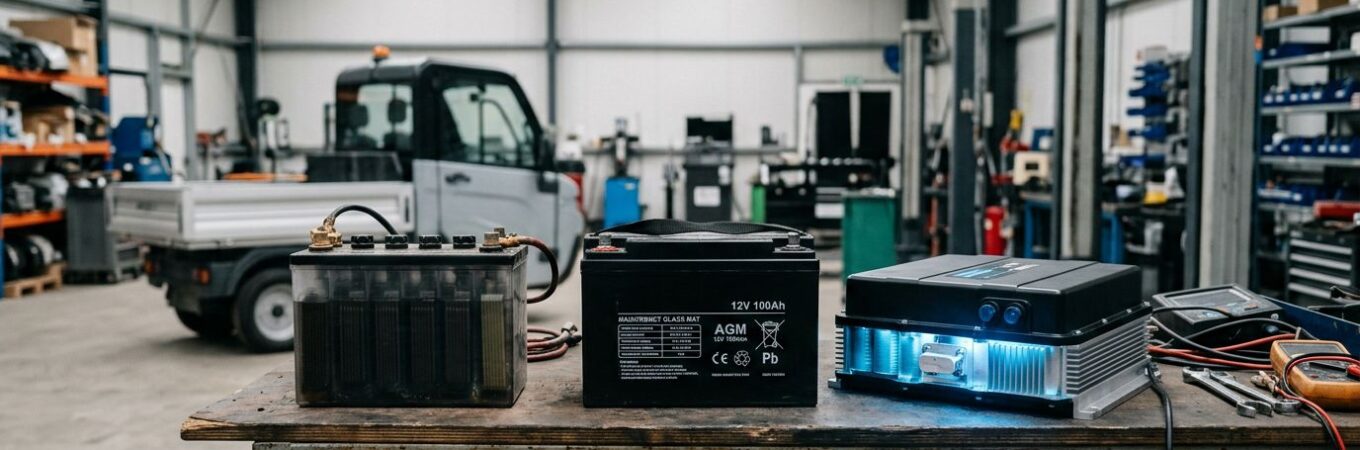
For most fleets running every day, LiFePO4 wins on total cost of ownership. AGM makes sense only for low-utilization or budget-locked fleets. Flooded lead-acid is now hard to justify outside the lowest-cycle, lowest-cost duty. That is the short answer in a LiFePO4 vs AGM vs lead-acid decision, and the rest of this guide shows you how to land on the right one for your operation.
Here’s the trap most buyers fall into. A distributor sources 60 utility carts for a coastal resort, picks the lowest sticker price, and ships flooded lead-acid packs. By the second summer, half the fleet is down to 60% range and the crew is topping up water weekly. Replacement packs are already on the next purchase order. The “savings” turned into two extra battery buys and a season of downtime.
You know your duty cycle better than any spec sheet. This guide gives you the numbers to spec correctly, the climate logic that decides heat and cold survival, and the honest cases where lead-acid is still the right call. We build these packs, so we will name the chemistry, the cycle life, and the trade-off behind each one.
Key Takeaways
– LiFePO4 delivers 3,000 to 7,000 cycles versus 300 to 700 for AGM and 500 to 1,200 for flooded lead-acid, so one LiFePO4 pack often outlasts three lead-acid replacements.
– LiFePO4 costs roughly 2 to 3 times more upfront, but high-use fleets reach break-even in about 12 to 18 months and run 30 to 50% lower TCO over 5 to 8 years.
– In 50°C Gulf heat, AGM loses capacity fast and LiFePO4 needs active cooling; in −40°C cold, bare LiFePO4 cannot charge below 0°C without a self-heating pack.
– AGM is the honest middle choice for low-utilization fleets, short hold periods, or sites with a weak electronics spare-parts pipeline.
– Fleet buyers should compare cost per cycle and downtime cost, not sticker price, and factor in charge-window and off-grid logistics.
The 30-Second Answer: Which Battery for Which Fleet
Pick the chemistry by how hard the fleet works and where it works, not by the price tag. The table below benchmarks the three options against the metrics that actually move fleet economics. Industry source ranges vary, so treat these as planning figures and confirm against the verified data sheet for the pack you spec.
| Metric | Flooded Lead-Acid | AGM | LiFePO4 (LFP) |
|---|---|---|---|
| Cycle life | 500–1,200 | 300–700 | 3,000–7,000 |
| Usable depth of discharge | ~50% | ~50% | 80–90% |
| Charge time (full) | 8–12 h | 6–10 h | 1–4 h |
| Charge efficiency | 70–80% | 75–85% | 90–95% |
| Weight (per usable kWh) | Heaviest | Heavy | ~1/3 of lead-acid |
| Maintenance | Watering, cleaning | Low | Effectively none |
| Upfront cost | Lowest | Low–mid | 2–3× lead-acid |
| Best fit | Low-cycle, budget duty | Low-use, sealed need | Daily, high-cycle fleets |
The pattern is consistent across utility carts, cargo trikes, and 1-ton pickups: the harder you cycle the battery, the more LiFePO4 pulls ahead. A fleet that charges once a day, six days a week, is a LiFePO4 case. A backup patrol cart that runs twice a week is not.
Want to match a chemistry to a specific platform? See the platforms we build across the full ORVIK lineup before you lock a spec, then spec the pack to the duty.
LiFePO4 vs AGM vs Lead-Acid: How the Three Chemistries Differ
All three store energy. How they degrade, charge, and survive heat is where fleet outcomes split. One idea matters most here: chemistry sets the ceiling on uptime.
Flooded lead-acid: the cheap, heavy, high-maintenance baseline
Flooded lead-acid is the lowest sticker price and the highest hidden cost. You can only use about half its rated capacity before you damage cycle life, and leaving it partly discharged invites sulfation that permanently cuts capacity. It needs routine watering, terminal cleaning, and equalization charging to stay healthy. In a busy fleet, that labor is real money and real downtime. It still earns a place in low-cycle, cost-locked duty, but the maintenance burden disqualifies it from heavy daily work.
AGM: sealed, maintenance-light, but still lead chemistry
AGM (absorbent glass mat) is sealed lead-acid. It removes the watering chore, tolerates vibration well, and ships maintenance-light, which is why it shows up in many starter packs. The catch: it is still lead chemistry, so the ~50% usable depth of discharge and the modest cycle life remain. AGM is a genuine middle step, not a lithium substitute.
LiFePO4: the cycle-life and efficiency leader
Lithium iron phosphate (LiFePO4, also written LFP) leads on the metrics fleets care about: cycle life, usable depth of discharge, charge speed, and efficiency. A managed LFP pack runs 3,000 to 7,000 cycles, accepts 80 to 90% depth of discharge, and converts roughly 90 to 95% of charge energy into work. It carries a battery management system (BMS) and weighs about a third of an equivalent lead-acid pack, which frees up payload. The cost is upfront capital and a need to respect temperature limits, which is where climate spec comes in. The cycle-life gap is the headline: in a LiFePO4 vs lead-acid utility vehicle pack, lithium routinely delivers several times the cycles before end of life, which is why one pack can outlast multiple lead-acid replacements.
Total Cost of Ownership: Why Upfront Price Lies
Sticker price is the worst way to compare fleet batteries. In any honest lithium vs lead-acid battery TCO comparison for a fleet, the metric that matters is cost per cycle plus the cost of downtime, and on that basis LiFePO4 usually wins for any fleet that works daily.
Run the math the way a procurement head does. Flooded lead-acid runs a low upfront cost per kWh; LiFePO4 runs roughly 2 to 3 times higher. But the lead-acid set delivers a fraction of the cycles and forces 2 to 3 full replacements over the life of a single LiFePO4 pack.
Now add the hidden costs. Count the labor of watering and equalization, the energy lost to 70 to 80% charge efficiency, and the revenue lost when a vehicle sits on charge or in the shop. Independent fleet studies put the lithium break-even at roughly 12 to 18 months, after which the lithium fleet runs as the lower-cost option, often 30 to 50% lower TCO over a 5 to 8 year hold. (See this industrial-EV battery TCO analysis for the underlying break-even logic.)
Consider an anonymized case. A resort grounds fleet of around 50 electric golf carts runs two shifts a day, six days a week. On flooded lead-acid, the operator replaced packs roughly every 2 years and carried a technician largely for battery upkeep. Modeled on LiFePO4 over the same 5-year window, the single-replacement cycle and the dropped maintenance labor moved total cost below the lead-acid baseline well before year three. The buyer who reads only the first invoice never sees that curve.
Ready to test the difference on your own numbers? Pull your daily cycle count and shift pattern, then get a factory-direct quote and we will model the chemistry against your duty cycle.
Climate Is the Deciding Factor: Heat, Cold, and Dust
Chemistry sets the ceiling; climate decides whether you reach it. A pack spec’d for a mild warehouse will fail in a Gulf summer or a CIS winter. This is where a generic global SKU breaks and a climate-adapted build pays for itself.
50°C Gulf heat: AGM fades, LiFePO4 needs cooling
Heat is the fleet killer in the Middle East. In an AGM vs lithium battery high-temperature comparison, both AGM and flooded lead-acid lose capacity and age faster above about 35°C, with water loss and plate corrosion accelerating through a 45 to 55°C summer. LiFePO4 tolerates heat better but still degrades faster when charged hot, so it needs thermal management to hold its cycle-life advantage. The answer is not just the cell. Our High-Temp Ready trim pairs an LFP pack rated for high-ambient duty with an upgraded radiator and a gel-encapsulated controller, because in 50°C dust the controller fails before the battery does.
A short scenario shows the stakes. A distributor in the Gulf shipped a batch on standard lead-acid; by the second summer the packs were down sharply on capacity and the controllers were failing one by one through the heat. The fix on the next order was a high-ambient LFP pack and a sealed controller, which moved the fleet from two seasons of service toward three or more. Same vehicle, different climate spec, an extra season of revenue.
−40°C CIS cold: never charge bare LiFePO4 below freezing
Cold inverts the problem. The golden rule for LiFePO4 is simple: never charge it below 0°C without warming it first, or you risk lithium plating that permanently cuts cycle life. Lead-acid can take a charge in the cold but loses cranking capacity and can crack in deep freeze. For Russia and CIS duty, the working answer is a self-heating LiFePO4 battery for cold weather that warms itself before accepting charge, which is exactly what our Arctic Ready package ships, cold-start verified toward −40°C with a self-heating pack and a diesel parking heater.
Dust and humidity: seal the electronics, not just the cell
In high-dust and high-humidity sites, ingress protection on the controller and BMS matters as much as the chemistry. A perfect pack behind an unsealed controller still puts the vehicle in the shop. Spec IP-rated, sealed electronics for mining, farm, and coastal duty regardless of which chemistry you choose.
The Honest Case for AGM and Lead-Acid
Most comparison articles pretend lithium always wins. It does not, and saying so is how you spec correctly. There are real fleets where AGM or flooded lead-acid is the right call, and pretending otherwise wastes a buyer’s capital.
Lead chemistry still makes sense when:
- Daily utilization is low. A patrol or backup cart that runs a few times a week may never reach the cycle count where LiFePO4 pays back.
- Cash flow is locked. When upfront capital is the hard constraint and the hold period is short, the lower purchase price can be the rational choice.
- The spare-parts pipeline is thin. LiFePO4 depends on a BMS and charger electronics. In sites with a shallow technician pool and slow electronics resupply, the simplicity of lead-acid can mean fewer hard-down days.
- The duty is genuinely seasonal. A fleet that works three months a year and sits the rest tilts the math back toward lead-acid.
This is the factory-honest read: the best battery is the one that matches your duty cycle, climate, and parts logistics, not the one with the best spec-sheet headline. If your operation fits the list above, AGM is a defensible choice, and we will quote it on a cost-sensitive trim.
Buying for a Fleet, Not a Single Vehicle
A single-vehicle buyer compares two batteries. A fleet buyer compares two operating systems. The decision criteria change at scale.
- Cost per cycle, not per pack. Divide pack cost by realistic cycle life at your depth of discharge. That single number reframes most “expensive” LiFePO4 quotes.
- Charge-window and hot-swap math. If a vehicle must turn around fast, LiFePO4’s 1 to 4 hour charge and hot-swap option keep units in rotation that lead-acid would park for 8 to 12 hours.
- Off-grid and weak-grid reality. On remote sites, charge source decides the spec. Pairing LFP packs with PV solar charging modules turns a weak grid from a constraint into a non-issue.
- FCL and spare-parts logistics. Standardize one chemistry across a container where you can, so the spare-parts kit and the repair procedure stay simple across the fleet. This holds whether you run golf carts, an electric tricycle line, or 1-ton pickups across the factory-direct utility EV lineup.
Spec’d this way, the battery decision stops being a line item and becomes an uptime decision, which is the only frame that matters over a 5-year hold.
Frequently Asked Questions
Is LiFePO4 always better than lead-acid for a fleet?
No. LiFePO4 wins for fleets that cycle daily, where its long cycle life and low maintenance drive down total cost of ownership. For low-use, short-hold, or budget-locked fleets, AGM or flooded lead-acid can be the rational choice. Match the chemistry to your actual duty cycle.
How much more does LiFePO4 cost than AGM or lead-acid?
Expect roughly 2 to 3 times the upfront cost per kWh. High-use fleets typically reach break-even in about 12 to 18 months because LiFePO4 lasts 3 to 5 times longer and needs almost no maintenance. Over a 5 to 8 year hold, lithium often runs 30 to 50% lower TCO.
Can LiFePO4 batteries work in extreme heat or cold?
Yes, with the right build. In 50°C heat, an LFP pack needs thermal management to protect cycle life. In sub-zero cold, never charge a bare LiFePO4 pack below 0°C; use a self-heating pack instead. Climate-adapted trims like High-Temp Ready and Arctic Ready handle both.
Why does AGM still get specified if LiFePO4 lasts longer?
AGM is sealed, maintenance-light, and far cheaper upfront, which fits low-utilization fleets, short hold periods, and sites with a thin electronics spare-parts pipeline. It is an honest middle step between flooded lead-acid and lithium, not a lithium replacement.
What battery is best for an off-grid or weak-grid fleet?
LiFePO4 paired with PV solar charging. Its high charge efficiency and deep usable capacity make the most of limited or intermittent power, and a self-heating or high-ambient trim keeps it reliable in extreme climates. Lead-acid wastes more of every scarce kilowatt-hour to heat and a shallow discharge limit.
The Bottom Line
In a LiFePO4 vs AGM vs lead-acid decision, the chemistry should follow the duty cycle and the climate, never the sticker price alone. Three takeaways carry the decision:
- For daily, high-cycle fleets, LiFePO4 wins on total cost of ownership despite the higher purchase order, with break-even in roughly 12 to 18 months.
- Climate decides survival. Spec a high-ambient LFP pack and sealed controller for Gulf heat, and a self-heating pack for CIS cold; a generic global SKU fails in both.
- AGM and lead-acid still win specific cases: low utilization, short hold, locked cash flow, or a thin parts pipeline.
Spec the battery as an uptime decision, not a line item, and the right chemistry usually picks itself. Tell us your daily cycle count, your climate, and your charge source, and request an FCL quote so we can model the chemistry against your operation. Make work flow.
ORVIK vehicles are intended for off-road and private-property use only in regulated markets. They are not certified for public-road operation in jurisdictions requiring DOT (US), EEC (EU), or equivalent homologation.

 English
  Russian
  Portuguese
  Arabic
  Japanese
  Korean
  Spanish
  French
  Hungarian