
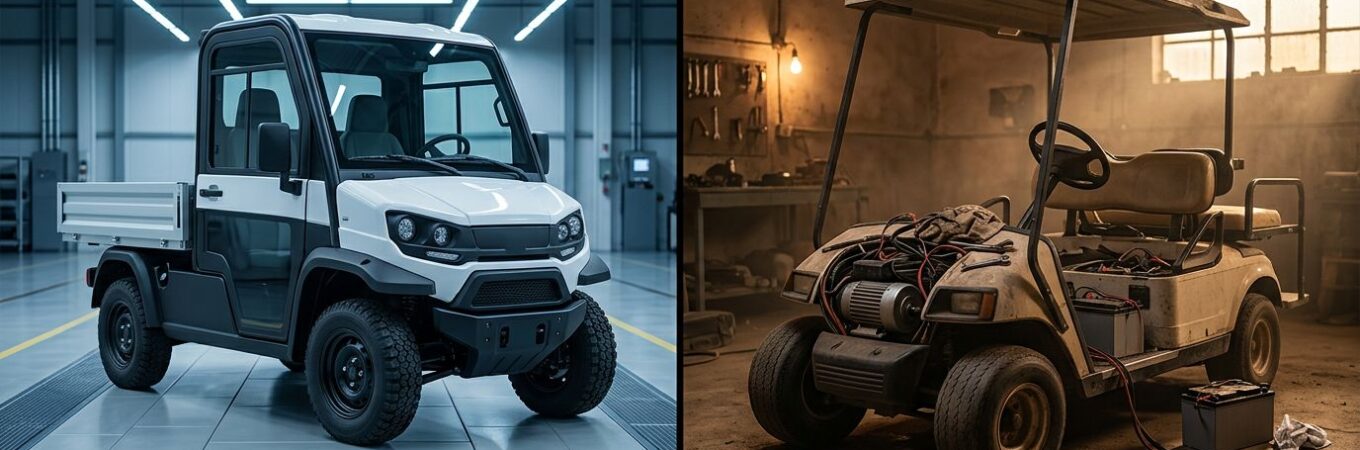
For a commercial fleet, a factory-built electric utility vehicle beats a conversion kit or a local retrofit on total cost of ownership, field-failure rate, and climate durability. The reason is simple: the same Chinese supply chain that makes the cheap conversion kit now also makes the purpose-built vehicle, so the kit’s only real advantage, a low sticker price, no longer holds.
That single fact has flipped the math for importers across the Middle East, Russia/CIS, Africa, and Latin America. Five years ago, bolting an electric drivetrain onto an existing diesel chassis could look like the cost-efficient route. Today it is usually the expensive one.
This guide gives you a fleet-grade decision framework. We will name the three “retrofit” routes buyers actually weigh, score them against seven procurement criteria, and show the climate engineering a bolt-on kit cannot replicate. If you are deciding whether to convert your current fleet or buy purpose-built, this is the spec walkthrough you need.
Key Takeaways
– The cheapest Chinese EV conversion kits cost about USD 2,000 to 5,000, but they ship with no thermal management, no warranty, and no parts pipeline, which is where fleet costs hide.
– A factory-built electric utility vehicle is engineered as one system: chassis, LiFePO4 pack, and controller sized to work together, not patched onto a frame built for an engine.
– In extreme climates, conversions fail first. ORVIK High-Temp Ready trim runs an LFP pack rated to 60°C; Arctic Ready cold-start is verified to −40°C.
– Over a 5-year hold, a converted unit’s downtime, voided warranty, and orphaned service erase the upfront saving.
– China’s EV volume drove motor, controller, and battery cost down so far that purpose-built is no longer a premium over conversion. The buy-vs-convert logic has flipped.
The Three “Retrofit” Routes Fleet Buyers Actually Consider
When a procurement lead says “we are looking at a conversion,” they usually mean one of three different things. Each carries a different risk profile, and each loses to a factory-built electric utility vehicle for a different reason.
ICE-to-electric conversion kits
This is the ICE-to-EV conversion route: a kit of motor, controller, charger, and battery pack bolted onto an existing gas or diesel utility vehicle. The cheapest Chinese kits run around USD 2,000 and include a 15 kW motor, controller, and charger, with higher-power variants near USD 5,000, according to reporting on Chinese conversion kits.
The problem is fit. A chassis designed around an engine compromises battery placement, weight distribution, and cooling. As the Wikipedia overview of electric vehicle conversion notes, you are adapting a platform that was never meant to carry a pack.
Local climate retrofits
Here the buyer imports a generic, global-SKU electric vehicle, then has a local workshop bolt on the climate hardware: aftermarket air conditioning, a cabin heater, controller sealing, or UV trim. The drivetrain is electric from the start, but the climate adaptation is aftermarket.
This is the route that strands fleets in desert and Arctic duty, because a sealed controller and a heat-rated pack cannot be added convincingly after the fact.
Used or refurbished EV imports
The third route is buying a second-life unit and patching it after landing. You inherit unknown battery cycles, no factory warranty, and no genuine parts pipeline. For a fleet that needs uptime, this is the highest-risk option of all.
Comparing your options before you commit? Browse the ORVIK product catalog → to baseline what a factory-built unit actually includes.
Factory-Built vs. Conversion vs. Retrofit: The 7-Criteria Decision Table
Procurement decisions are not won on sticker price. They are won on the seven criteria below, measured over the hold period. Here is how a factory-built electric utility vehicle compares against the conversion and retrofit routes.
| Criteria | Factory-built (purpose-built) | ICE-to-EV conversion kit | Local climate retrofit |
|---|---|---|---|
| 5-year TCO | Lowest (predictable) | High (downtime + rework) | High (rework + failures) |
| Field-failure rate | Low, engineered system | High, mismatched parts | Medium-high, bolt-on climate |
| Thermal management | Designed in (sealed, rated) | Usually absent | Aftermarket, unreliable |
| Warranty | Factory-direct, 12 months+ | None / voided | Voided on base vehicle |
| Spare parts | Container parts kit included | Buyer-sourced, generic | Mixed sources |
| Lead time | 60 to 90 days, planned | Variable + labor | Import + workshop queue |
| Off-grid readiness | PV / swap as factory option | Not native | Not native |
The pattern is consistent. Conversions and retrofits can win line one, the purchase price, and lose every line after it. A purpose-built electric vehicle wins the lines that decide a 5-year fleet budget.
This matches the broader market finding. Consumer Reports concluded that purpose-built electric vehicles outperform converted models, because engineering the whole platform around the drivetrain beats adapting one that was not.
Why Conversions Fail First in Extreme Climates
Most buy-vs-convert articles stop at efficiency. For our markets, the deciding factor is climate. A vehicle that runs fine in a temperate city fails fast at 50°C in the Gulf or −30°C in Kazakhstan. This is where a factory-built electric utility vehicle separates from any retrofit.
Heat-soak and dust: sealed by design, not bolted on
Picture the common failure pattern in a Gulf logistics operation. A fleet converts its diesel carts with low-cost kits to save capital. The kits run fine through spring. Then a 50°C summer arrives: open controllers draw dust and heat-soak, and units start failing through the hottest months. With no genuine parts pipeline and no factory warranty, the fleet can sit idle at peak season. This is an illustrative scenario, not a named case, but it tracks the real-world failure mode of bolt-on kits in desert heat.
A factory-built unit closes that gap at the source. ORVIK High-Temp Ready trim ships a gel-encapsulated controller rated against dust and heat ingress, UV-stable polymer panels, an upgraded radiator, and an LFP pack rated to 60°C. The seal is part of the build, not a workshop afterthought.
Cold-start: a self-heating pack, not a retrofitted one
The cold-climate failure mode is the mirror image. Consider a CIS patrol operation that retrofits cabin heaters onto imported generic carts for winter duty. The cabin warms; the battery does not. In deep cold, a pack that was never built to self-heat will not take a reliable charge, and morning cold-starts stall the schedule. Again, this is an illustrative pattern rather than a specific customer.
ORVIK Arctic Ready trim solves this in the build: a self-heating LiFePO4 pack, a diesel parking heater, low-temperature lubricant, and cold-start verified to −40°C. A retrofit warms the driver. A purpose-built pack warms the chemistry that actually has to start.
The TCO Math: Why “Cheap Upfront” Loses Over a 5-Year Hold
Total cost of ownership, not list price, decides a fleet budget. Run the conversion route all the way out and the upfront saving disappears.
Start with the kit: USD 2,000 to 5,000 per vehicle. Then add the lines that never show up in the kit quote:
- Labor to install, wire, and commission each unit.
- Voided warranty on the base vehicle, since the conversion changes the drivetrain.
- Failure downtime, measured in weeks when there is no parts pipeline.
- No genuine spare parts, so each repair is a sourcing project.
- Thermal risk, since cheap kits commonly ship without thermal management or safety cutoffs.
A factory-built electric utility vehicle replaces every one of those unknowns with a planned number. ORVIK ships a container-sized spare-parts kit with every full container load, plus a repair-video library covering more than 90% of common field failures, and a factory-direct 12-month warranty. Downtime is measured in hours, not weeks.
The cheap kit looks like a saving on day one. By month 18, the converted fleet has usually spent more, and lost more revenue to downtime, than the purpose-built fleet ever cost.
Ready to model the real number for your fleet? Contact ORVIK for a factory-direct FCL quote → and we will run your container math against your duty cycle. For the full breakdown, see our 5-year TCO analysis for industrial fleets.
How “Made in China” Flipped the Buy-vs-Convert Logic
For years, conversion made sense for one reason: building or buying a purpose-built electric vehicle cost more than electrifying what you already owned. That reason is gone, and Chinese manufacturing is why.
China produces electric vehicles at a volume that has driven the cost of motors, controllers, and battery packs far below US or EU component pricing. The integrated supply chain in Guangdong, Shandong, and Jiangsu means the same suppliers feed both the conversion-kit makers and the vehicle plants.
So the kit and the finished vehicle now draw from the same cost base. When the parts cost roughly the same either way, paying for a chassis engineered around those parts, instead of one fighting them, is the obvious choice.
This is the reframe that matters for procurement. The question is no longer “China versus the West.” Chinese factories win that on price already. The real question is “Chinese factory vehicle versus the conversion shortcut,” and the shortcut has lost its only edge.
A factory-direct relationship sharpens the advantage further. Buying from the plant means source pricing, a transparent bill of materials, and warranty handled by the people who built the vehicle, not bounced to a sub-supplier or a broker.
How to Spec a Factory-Built Fleet Instead
If you are ready to skip the conversion route, here is the procurement checklist for spec’ing a factory-built electric utility vehicle correctly.
- Name the climate first. High-Temp Ready for the Gulf, Arctic Ready for CIS winters, Off-Grid Ready for weak-grid sites. The trim drives reliability more than any other choice.
- Size the payload to the job. ORVIK platforms run from a farm-and-mining electric cargo trike up to an off-road electric utility vehicle for mining and resort duty. Match the platform to the load.
- Specify gradeability loaded. Gradeability on the utility platform matters for ramps, construction sites, and sand-track yards. Confirm the loaded figure with the plant for your duty cycle.
- Choose the charging mode. Onboard charger as standard, with PV modules or hot-swap packs where the grid is weak. Specify the off-grid energy option that pairs with your vehicle line.
- Confirm the FCL and MOQ math. Single-SKU container loading maximizes unit density and standardizes your spare-parts list across the fleet.
- Verify the parts kit and warranty. Container-sized parts kit, repair-video access, and factory-direct warranty should be in the quote, not an upsell.
Spec it this way and you buy uptime, not a project.
Watch: factory build vs. conversion, explained
Video placeholder: embed a relevant YouTube walkthrough showing factory-built drivetrain integration versus a bolt-on conversion. Prefer ORVIK channel footage; fall back to an authoritative third-party explainer.
Frequently Asked Questions
Is it cheaper to convert a vehicle to electric or buy one?
For a single hobby vehicle, conversion can be cheaper. For a commercial fleet, buying a factory-built electric utility vehicle is cheaper over the hold period, because conversion adds labor, voided warranty, downtime, and parts-sourcing costs that a purpose-built unit avoids. The same hold-period logic decides the electric-versus-diesel question, covered in our breakdown of when an electric utility vehicle beats an ICE pickup.
Are EV conversion kits reliable for commercial fleets?
Generally no. Cheap kits often ship without thermal management or safety cutoffs, and they mount on a chassis not designed for a battery. Reliability suffers most in heat, cold, and dust, exactly the conditions our markets operate in.
Why do converted EVs fail in hot or cold climates?
Climate hardware bolted on after import cannot match a designed-in system. A retrofit heater warms the cabin but not the battery; an open controller draws dust and heat-soaks. Factory trims seal and rate the controller and pack from the build, verified to 60°C and −40°C.
Can you buy electric utility vehicles factory-direct from China?
Yes. ORVIK sells factory-direct from its plant in Xinpengcheng, Shandong, in single-SKU full container loads, with source pricing, climate-adapted trims, and a spare-parts kit per shipment.
Does an EV conversion void the vehicle warranty?
Yes, in most cases. Converting the drivetrain changes the vehicle from what the original maker certified, which voids the base warranty and leaves you without factory service. A factory-built unit carries its own warranty intact.
Conclusion: Buy the Tool, Not the Project
The buy-vs-convert decision used to hinge on price. It no longer does. A factory-built electric utility vehicle now wins on the criteria that decide a fleet budget, and the conversion route has lost the one advantage it ever had.
Three things to take into your next procurement review:
- Score the full picture, not the sticker. TCO, field-failure rate, warranty, and parts pipeline decide the real cost.
- Let the climate drive the spec. A sealed, heat-rated, or self-heating build is the difference between a fleet that runs and one that sits.
- Use the flipped logic. The same Chinese supply chain makes the kit and the vehicle, so the purpose-built unit is no longer a premium.
Spec the climate, size the payload, confirm the parts kit, and buy the vehicle that was built to do the job. Make work flow.
Contact ORVIK to spec your fleet and request an FCL quote → and we will spec the right trim, payload, and charging mode against your route.
ORVIK vehicles are intended for off-road and private-property use only in regulated markets. They are not certified for public-road operation in jurisdictions requiring DOT (US), EEC (EU), or equivalent homologation.

 English
  Russian
  Portuguese
  Arabic
  Japanese
  Korean
  Spanish
  French
  Hungarian